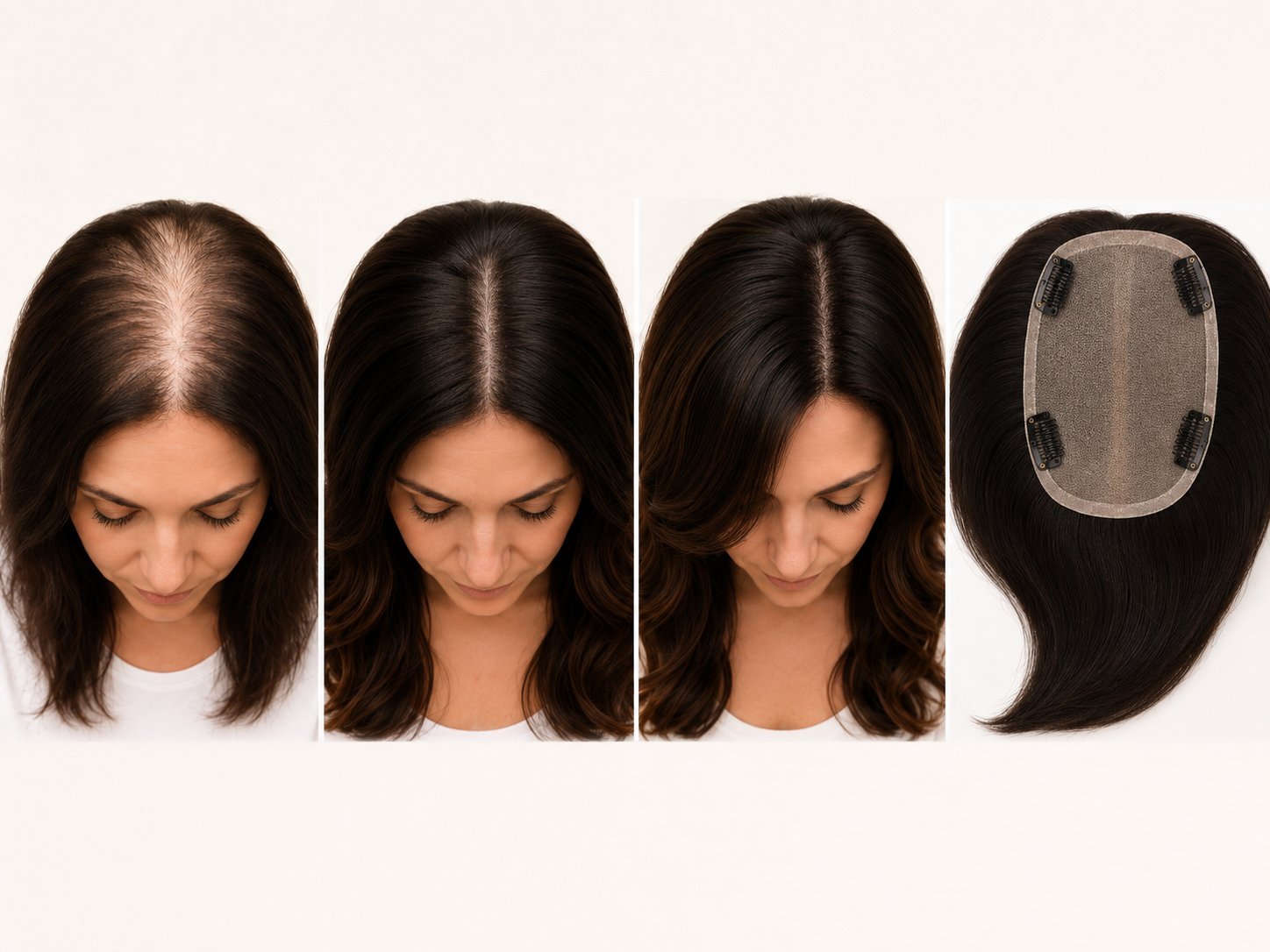
A women’s hair topper looks natural only when the coverage matches the thinning area. A small base may leave scalp showing at the crown. A base that is too large can feel bulky or pull at the clips. The first question should be: where is the hair thinning?
Some women notice a wider part after styling. Some see a bright spot at the crown in photos. Others struggle with a weak front hairline. Each case calls for a different base size, base material, hair direction, and attachment plan.
A women’s hair topper is a partial hairpiece made to add coverage and volume to the top of the head. It is not a full wig because it blends with the wearer’s own hair. It is also different from extensions, which mainly add length at the sides and back.
A human hair topper can help when the scalp shows through the top layers but there is still enough natural hair around the thinning area for clips or other attachment methods. Common use cases include thinning crown, widening part line, flat top volume, front thinning near the hairline, and early to moderate female hair loss.
Crown thinning usually appears around the natural swirl at the back top of the head. It may look mild in the mirror, but it often shows under ceiling lights, in photos, or when hair separates during the day. A hair topper for thinning crown needs enough base area to cover both the visible scalp and the weak hair around it.
For light crown thinning, a smaller crown hair topper may work if the sparse area is limited. For moderate thinning, a medium base is safer because it covers the thin spot and nearby weak hair. If thinning spreads from the crown toward the part line, a larger custom hair topper may give a flatter finish.
Clips should not sit directly on fragile hair. They need to fasten into stronger hair outside the thinning zone. A mono hair topper is often chosen for crown coverage because the base is durable, breathable, and easy to part. A silk top hair topper can give a soft scalp look from above.
A widening part line can be subtle at first. The part looks pale, wide, or uneven. The hair may still be long and healthy at the ends, yet the top looks flat. In this stage, a hair topper for widening part can give a more natural result than a full wig.
A part line hair topper does not always need a large base. In many cases, a light or medium piece is enough. The key is the part direction. If the wearer changes between middle and side parts, a mono base or silk top base with flexible styling may be better.
Root color matters more than end color. A poor root match can make the topper obvious. Density also needs care. Very thick hair on top may look unnatural next to fine biological hair. For most daily users, medium-light to medium density gives a softer blend.
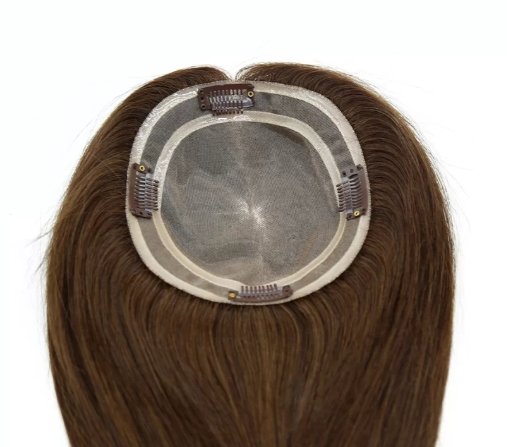
Front thinning is harder to cover because the hairline is always visible. A standard topper placed too far back may cover the top but still leave sparse baby hairs or temples exposed. A front thinning hair topper needs careful design around the front edge.
If the natural front hairline is still strong, the wearer can place the topper slightly behind it and blend her own hair over the front edge. If the front hairline is thin, uneven, or receding, a lace front topper or frontal hairpiece may be more suitable. Lace gives a softer front edge and cleaner hairline coverage.
When thinning affects the crown, part line, and front hairline together, a women’s full wig may give better overall coverage, especially if there is not enough strong hair left for clips.
Before choosing a women’s hair topper, measure the area that needs coverage. Use a soft tape measure and check in natural light. Measure from front to back and from side to side. Add a small margin so the base reaches stronger hair.
Thinning Area | Coverage Need | Better Choice |
Narrow part line | light top coverage | small silk top or mono topper |
Crown spot | crown and top coverage | medium crown hair topper |
Crown plus part line | wider top coverage | larger custom hair topper |
Front plus top thinning | hairline and top coverage | lace front topper or frontal piece |
Advanced thinning | full-head coverage | women’s full wig |
A common mistake is buying by hair length alone. Length helps with blending, but base size decides coverage. A shorter custom women’s hair topper with the right base can look more natural than a long piece with the wrong base.
Base material affects comfort, airflow, scalp appearance, and service life. The best choice depends on where the thinning appears and how often the topper will be worn.
A silk top hair topper is popular for women who want the part line to look like hair growing from the scalp. It works well for widening part and top thinning. The base may feel slightly thicker than lace, but the visual effect can be very natural.
A mono hair topper is a practical choice for daily wear. It is breathable, strong, and allows flexible parting. Salons often use mono toppers for clients who need a balance between natural look and durability.
A lace front topper is useful when front thinning or hairline blending is the main concern. An integration hair topper allows the wearer’s own hair to be pulled through the base, which can work well when the top needs more volume.
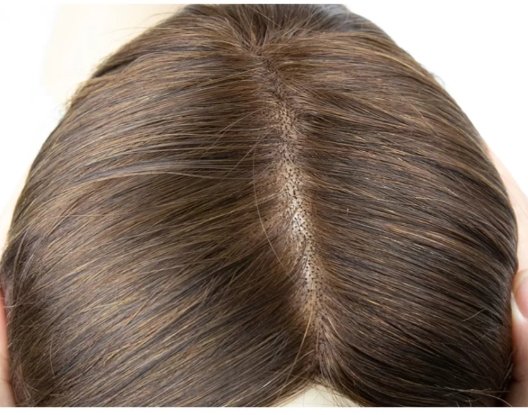
A natural looking hair topper comes from several small details working together. The base must cover the right area. The color must match the roots and ends. The density should not overpower the wearer’s own hair.
For daily wear, these details make a clear difference:
· choose root color before choosing highlight color
· match straight, wavy, or curly texture to natural hair
· keep density realistic for age and natural hair volume
· trim the topper after fitting, not before
· place clips on healthy hair, away from sore or thin spots
Human hair toppers made with Remy hair or virgin hair can be cut, colored, and styled more easily than many synthetic options. Indian hair, Chinese hair, Mongolian hair, and European hair each have different texture profiles, so a custom hair topper can be made closer to the wearer’s natural hair feel.
Qingdao Eminent Hair Products Co., LTD is a professional hair product manufacturer based in Qingdao, China. The company produces men’s hair replacements, women’s wigs, hair toppers, frontals, full wigs, repair pieces, and custom hair systems.
Its production team includes around 50 factory workers and about 500 knotting workers. This setup supports hand-tied work, custom base designs, stock pieces, and repeat wholesale orders. Lace, mono, silk top, skin, and integration bases can be made for different wear needs. Indian hair, Chinese hair, Mongolian hair, and European hair are available, with Remy hair and virgin hair options.
For salons, distributors, and individual buyers, base size, hair length, density, curl, color, and hair type can be adjusted for crown thinning, widening part line, front thinning, or full-head coverage. A useful topper range should include small part line toppers, medium crown toppers, lace front toppers, and custom base options. Wholesale women’s hair toppers should be planned by coverage type, not only by length and color. For private label sellers, consistent density, base size, hair direction, and color matching are just as important as price.
A women’s hair topper should be chosen by coverage area first. Crown thinning usually needs a medium or larger base. A widening part line may need a smaller silk top or mono topper with a natural part. Front thinning may call for a lace front topper, frontal piece, or full wig if the hairline is too weak.
The right topper solves a specific visibility problem. When the base, color, density, and attachment points match the wearer’s real hair condition, the result looks softer, feels safer, and works better in daily life.
For a thinning crown, the topper base should cover the visible sparse area plus a small margin around it. A medium crown hair topper is often better than a very small base because the clips can sit in stronger hair.
Yes. A hair topper for widening part can cover a pale or wide part line while blending with the wearer’s own hair. A silk top hair topper gives a realistic scalp look, while a mono hair topper gives flexible parting and good airflow.
The best option depends on how strong the natural front hairline is. If the front hair is still dense enough, a topper can sit slightly behind it. If the front hairline is visibly thin, a lace front topper or frontal hairpiece may give better hairline coverage.
The quality of the products is the foundation of our existence!Customers'satisfaction is our permanent commitment!

Follow us on social media and find more about our hair procedures and for our latest news, photos and success stories.
TELEPHONE :+86-18765287179
WHATSAPP :+86-18765287179


© 2026 Qingdao Eminent Hair Products Co.,LTD. All Rights Reserved. Powered by HiCheng